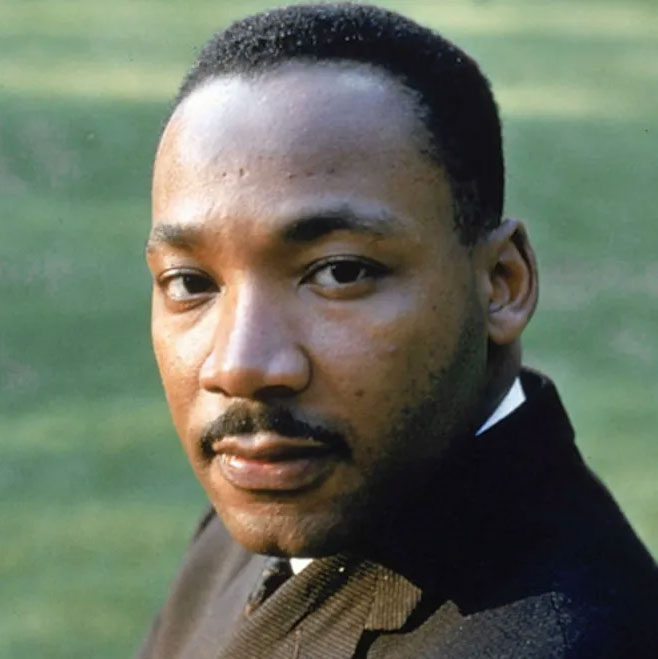
Martin Luther King Jr. (1929–1968) was a Baptist minister, civil rights leader, and Atlanta native who became the most influential voice of the modern Civil Rights Movement. Through disciplined nonviolent action and moral leadership, Dr. King helped dismantle legalized segregation and expand civil and voting rights in the United States while shaping global conversations on justice and human dignity.

Martin Luther King Jr. was born on January 15, 1929, in Atlanta, Georgia, and raised in the Sweet Auburn neighborhood, one of the most significant Black economic, cultural, and political centers in the country. He was the son of Martin Luther King Sr., a prominent pastor at Ebenezer Baptist Church, and grew up in an environment deeply rooted in faith and community leadership. These early influences would shape his understanding of justice as both a moral and civic obligation.
King attended Morehouse College before continuing his theological education at Crozer Theological Seminary and earning a doctorate in systematic theology from Boston University. During his studies, King refined his philosophy of nonviolence, drawing inspiration from Christian theology and the teachings of Mahatma Gandhi. This approach would become the foundation of his leadership style and organizing strategy.
King rose to national prominence in 1955 as the spokesman of the Montgomery Bus Boycott, a year-long protest initiated by the African-American population of Montgomery, Alabama to force integration of the city’s bus lines. The boycott highlighted the role of everyday public systems, particularly transportation, in enforcing racial inequality. Its success demonstrated the power of collective action and positioned King as a central figure in a growing movement for civil rights.
In 1957, King was elected president of the Southern Christian Leadership Conference (SCLC), head quartered in Atlanta. Through the SCLC, he coordinated nonviolent campaigns across the South aimed at dismantling segregation and securing equal access to education, employment, housing, and public accommodations. Major campaigns in Birmingham and Selma exposed the brutality of segregation to a national audience and galvanized public support for legislative change.
King’s leadership directly influenced the passage of transformative federal laws, including the Civil Rights Act of 1964, which outlawed segregation in public spaces and employment, and the Voting Rights Act of 1965, which removed barriers that had long disenfranchised Black voters. In 1964, he received the Nobel Peace Prize, recognizing his commitment to nonviolence and human rights at a time of profound social division.
Beyond civil rights legislation, King increasingly spoke out on economic inequality, labor rights, and the moral consequences of war. His later work emphasized the interconnectedness of racial justice, economic opportunity, and peace, reinforcing the idea that true equality required structural as well as legal change. Until his assassination in 1968, King remained a leading voice calling the nation to live up to its democratic ideals.
Streets, bridges, and public corridors were central to King’s work, serving as visible stages for peaceful protest and civic expression. From marches through Southern cities to the 1963 March on Washington, where he delivered his iconic “I Have a Dream” speech, public space became a powerful symbol of collective action and democratic participation.
The naming of Martin Luther King Jr. Drive honors both Dr. King’s enduring legacy and Atlanta’s role as a birthplace and hub of the Civil Rights Movement. The corridor stands as a reminder that the city’s streets have long been more than routes of travel. They are places where history unfolded, voices were raised, and the ongoing pursuit of justice continues.